
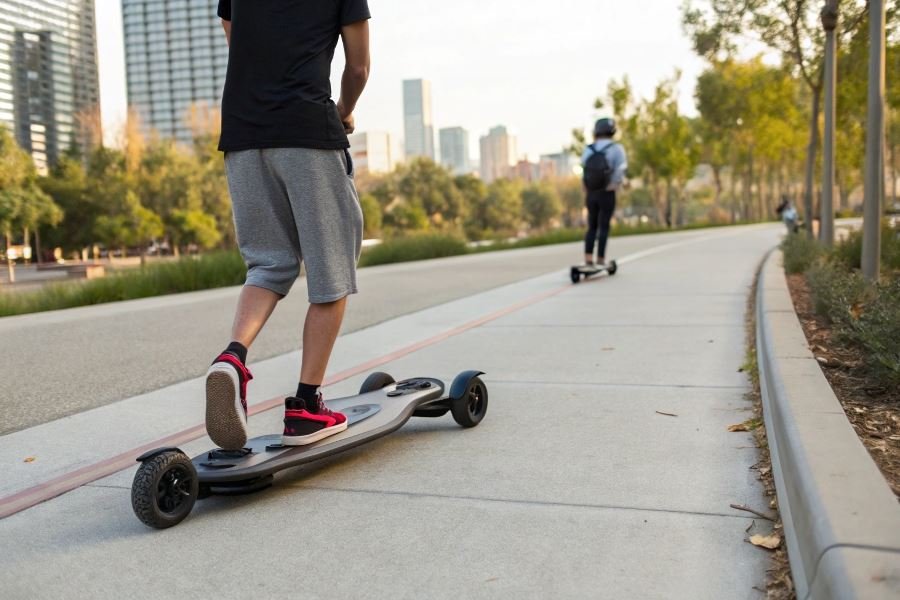
Ever stood at the top of a steep hill, heart pounding, with nothing but a board between you and the rushing asphalt below? That’s downhill longboarding—where speed demons find their ultimate rush, hitting speeds that can exceed 60 mph on the right terrain.
Downhill longboarding isn’t just an extreme sport; it’s a precise science where equipment selection can mean the difference between an exhilarating ride and a trip to the emergency room. Unlike casual cruising boards, downhill longboards are purpose-built speed machines designed to remain stable when gravity takes control.
The downhill difference
What separates a downhill longboard from its casual cousins? Stability at speed is non-negotiable. This typically means:
- Deck construction with multiple plies of maple or composite materials
- Lower riding platforms to reduce the center of gravity
- Precision trucks that minimize speed wobbles
- Wheels with specialized durometers and profiles for grip
Safety: Your first priority
Before chasing the adrenaline rush, understand that downhill riding demands respect. Professional riders don’t just grab any board and bomb hills—they meticulously select gear that complements their riding style and the terrain they’ll tackle.
“Your helmet doesn’t just protect your head; it protects your future.”
Full-face helmets, slide gloves, knee pads, and elbow protection aren’t optional accessories—they’re essential equipment that should be factored into your budget alongside your board components.
When selecting your downhill setup, remember: the right board doesn’t just perform better—it keeps you safer when you’re dancing with gravity.
The Anatomy of Speed: Downhill Longboard Components
When you’re bombing hills at 40+ mph, every component of your longboard becomes a critical piece in the survival puzzle. Selecting the right deck, trucks, and wheels isn’t just about preference—it’s about creating a balanced system that delivers control when gravity takes over.
Understanding longboards for downhill: features of selection requires deep knowledge of how each component affects stability, control, and speed management. Let’s break down the essential elements that separate casual cruisers from dedicated downhill machines.
Deck Construction: The Foundation of Control
The deck is your platform—your connection to the board and the road. For downhill, you need specific characteristics:
Construction Materials Matter:
- Maple – Traditional 7-9 ply maple decks offer reliable stiffness and predictable flex
- Carbon Fiber – Provides superior stiffness-to-weight ratio for responsive control
- Fiberglass – Often layered with maple to add torsional stiffness without excess weight
Shape and concave determine how locked-in you feel at speed. Deep concaves like W-concave or tub concave create reference points for your feet, crucial when tucking or sliding at high speeds.
| Deck Type | Best For | Typical Width |
|---|---|---|
| Drop Platform | Beginners, stability | 9.5-10″ |
| Top Mount | Advanced, leverage | 9-10″ |
| Drop Through | Mid-level, stability | 9-10.5″ |
Truck Geometry: The Science of Stability
Truck selection might be the most technical aspect of downhill longboard setup. The geometry directly impacts how your board responds at speed.
Critical Truck Factors:
- Baseplate Angle – Lower angles (42-45°) increase stability; higher angles (50°+) increase turn responsiveness
- Hanger Width – Wider hangers (180mm) provide stability; narrower (150-165mm) offer quicker response
- Rake – Positive rake creates a more progressive turn; zero rake delivers linear turning
Precision trucks from manufacturers like Aera or Ronin offer machined perfection that eliminates slop—the enemy of predictability when you’re pushing speed limits.
Wheels: Where Rubber Meets Road
Your wheels are your final connection to the pavement, and their characteristics dramatically affect grip, slide initiation, and speed control.
The Wheel Trifecta:
- Durometer – Softer wheels (75a-80a) provide grip; harder (82a-86a) slide more predictably
- Diameter – Larger wheels (70-76mm) maintain speed; smaller wheels (65-70mm) accelerate quicker
- Core Placement – Centerset cores slide consistently; offset cores provide directional grip
Lip Profile Matters: Square lips grip corners like they’re on rails, while rounded lips break traction more predictably for controlled slides.
The urethane formula is equally crucial—premium wheels from Orangatang or Seismic use proprietary formulas that balance grip, wear resistance, and slide characteristics.
When selecting components for downhill longboarding, remember that everything works as a system. The perfect deck means nothing with inappropriate trucks, and premium trucks can’t compensate for poor wheel selection. The magic happens when all elements work in harmony, creating a board that feels like an extension of your body as you carve down mountain passes at speeds that would make your mother nervous.
Dialing In Your Downhill Setup: Advanced Considerations
How Rider Weight and Skill Level Shape Your Choices
Your physical attributes and experience level aren’t just minor factors—they’re fundamental determinants of your ideal downhill longboard setup. A 220-pound rider needs substantially different equipment than someone weighing 140 pounds.
Heavier riders benefit from:
- Stiffer decks with 9-10 plies of maple
- Wider trucks (180mm+) for stability
- Harder bushings (90-97a durometer)
- Wider wheels (70-76mm) with supportive cores
Meanwhile, lighter riders can enjoy more responsive setups with:
- Slightly more flexible decks (7-9 plies)
- Narrower trucks (165mm) for quicker turning
- Medium bushings (85-90a)
- Slightly smaller wheels (65-72mm)
Skill progression demands equipment evolution. Beginners should prioritize stability over maneuverability, with drop-through mounts and 50° baseplate angles. As you advance, top-mounts with split-angle truck setups (43° rear, 50° front) offer that perfect balance of speed control and turning precision.
The most common mistake isn’t buying cheap gear—it’s buying advanced equipment before you’re ready. Your setup should match where you are now, not where you want to be.
Terrain-Specific Adaptations That Make All The Difference
Different hills demand different weapons. The longboard that conquers your local sweeper won’t necessarily dominate a technical mountain pass.
Open Road Bombers
For those long, straight descents with minimal turns, maximize stability with:
- Longer wheelbase (26-30″)
- Lower degree trucks (40-44°)
- Center-set wheels with wide contact patch
- Minimal concave for comfortable tuck position
Technical Canyon Carvers
When facing hairpins and tight switchbacks:
- Shorter wheelbase (24-27″)
- Higher degree front truck (50°) with lower degree rear (43°)
- Offset wheels with sharp lips for grip
- Deep concave with wheel flares for leverage
Urban Hill Slayers
For city hills with rough pavement and unexpected obstacles:
- Medium wheelbase (25-28″)
- Symmetrical truck setup (both 50°)
- Softer wheels (78-82a) to absorb vibration
- Kicktail for quick maneuvers
Top 3 Complete Setups Worth Every Dollar
| Level | Complete Setup | Key Features | Approximate Price |
|---|---|---|---|
| Beginner | Landyachtz Switchblade with Paris V3 180mm trucks and Orangatang Kegel 80a wheels | Drop-through platform with drop deck for ultra-low riding height; stable at speed; forgiving for beginners | $280 |
| Intermediate | Rayne Darkside with Caliber III 44° trucks and Powell Peralta Snakes | Top-mount with wheel wells; versatile for both freeride and downhill; progressive concave | $320 |
| Advanced | Pantheon CHiller with split Aera RF-1 trucks (46°/30°) and Venom Magnums | Race-ready precision; aggressive concave with rocker; designed for maximum tuck efficiency | $450 |
Each of these setups offers room to grow within their skill bracket. The Landyachtz forgives mistakes, the Rayne rewards technique development, and the Pantheon setup unlocks racing potential for those ready to push limits.
Remember that even the most expensive setup won’t make you faster without proper technique. Invest in safety gear first, then gradually upgrade components as your skills demand more from your equipment.