
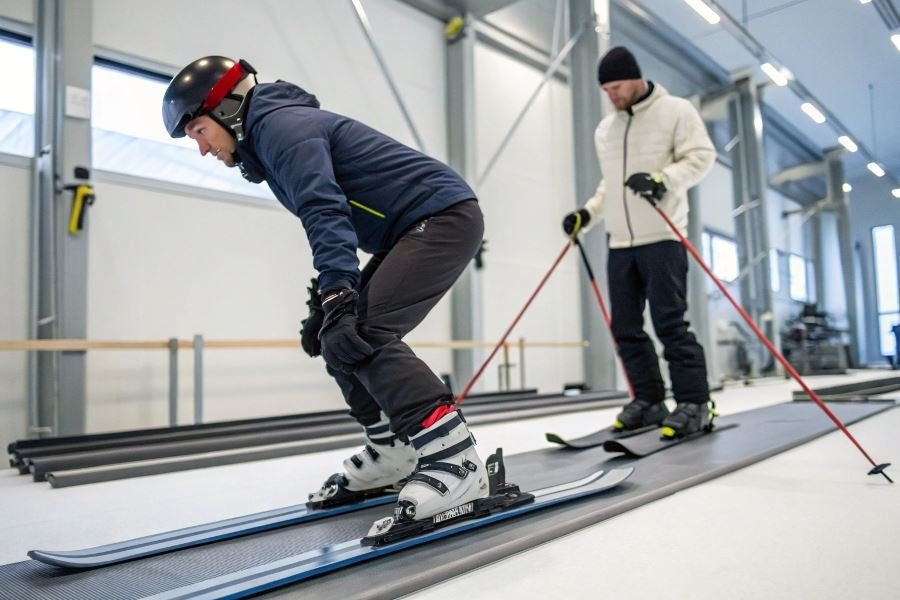
Ever wondered how Olympic skiers maintain peak performance during the off-season? The answer might be sitting in your local gym—or even your living room. Ski simulators have revolutionized how we prepare for the slopes, offering year-round training that transforms winter novices into confident downhill enthusiasts.
When you’re just starting your journey with ski simulator training, you’re not just preparing for your next mountain adventure—you’re engaging in a full-body workout that rivals most gym routines. These machines brilliantly mimic the lateral movements and muscle engagement of actual skiing, building strength in your quads, hamstrings, and core while improving balance and coordination. Research shows just 20 minutes on a ski simulator can burn up to 400 calories while significantly reducing injury risk when you hit actual snow.
The simulator spectrum: Finding your perfect match
Ski simulators come in surprising variety:
- Sliding platforms offer side-to-side movement with adjustable resistance
- Balance boards focus on stability and core strength
- Full-motion simulators provide the most realistic experience with programmable terrain
For beginners, sliding platforms typically offer the gentlest learning curve while still delivering substantial benefits. Many models now include digital feedback systems that track your progress and form—perfect for self-correction when you’re training solo.
Setting your beginner expectations
Don’t expect to transform into Lindsey Vonn or Bode Miller overnight! Your first sessions will focus on finding balance and developing proper form. Most beginners see noticeable improvement within 2-3 weeks of consistent practice (3-4 sessions weekly). The beauty of simulator training lies in its forgiving nature—you’ll build muscle memory and technique without the intimidation factor of an actual slope.
Remember: consistency trumps intensity when you’re starting out. Your body needs time to adapt to these new movement patterns!
Master the Slopes with Proper Technique
Stepping onto a ski simulator for the first time can feel like balancing on a moving cloud. The smooth glide, the lateral motion, the burn in muscles you didn’t know existed – it’s a whole new world of fitness. Learning how to train on a ski simulator effectively requires understanding fundamental techniques that will transform awkward movements into fluid, powerful strides.
Perfect posture is your foundation. Before you even start moving, position yourself with slightly bent knees, hips hinged forward, and your core engaged. Your weight should be centered over the middle of the platform, not leaning back (a common beginner mistake). Keep your head up and shoulders relaxed – imagine a string pulling you up from the crown of your head while your lower body remains flexible and responsive.
Body Positioning That Powers Performance
The magic of ski simulator training happens when your body alignment works with the machine, not against it. Keep your feet hip-width apart with toes pointing forward. Your arms should swing naturally opposite to your legs, just as they would during actual skiing or walking.
The difference between effective and inefficient training often comes down to where you’re looking. Fix your gaze forward, not down at your feet. This helps maintain proper spinal alignment and prevents the hunched posture that leads to back strain and reduced workout efficiency.
Movement Patterns That Build Skill
Start with basic lateral movements, pushing side to side with gentle pressure. The key is controlled, smooth transitions rather than jerky movements. Begin with:
- Basic glide – Focus on equal weight distribution and smooth transitions
- Short strokes – Quick, controlled side-to-side movements
- Long, extended glides – Emphasize the full range of motion
As you gain confidence, incorporate arm movements that mirror cross-country skiing techniques. Your opposite arm and leg should move forward simultaneously, creating a balanced, coordinated motion that engages your entire body.
Progressive Training Blueprint
The journey from beginner to skilled ski simulator user follows a clear progression:
| Week | Duration | Focus | Intensity |
|---|---|---|---|
| 1-2 | 10-15 min | Form and balance | Low |
| 3-4 | 15-20 min | Rhythm and consistency | Low-Medium |
| 5-6 | 20-30 min | Endurance building | Medium |
| 7-8 | 30+ min | Interval training | Medium-High |
Begin with shorter sessions focused entirely on technique. Many enthusiasts make the mistake of cranking up resistance too quickly, which compromises form and can lead to injury. Instead, master the movement patterns at lower resistance levels before gradually increasing the challenge.
Listen to your body’s feedback. The burn in your quads, hamstrings, and glutes should feel challenging but manageable. If you’re experiencing joint pain rather than muscle fatigue, reassess your technique immediately.
Incorporate variety by changing your stance width occasionally. A narrower stance targets different muscle groups than a wider one, providing a more comprehensive lower body workout. As your confidence grows, experiment with adding slight rotational movements to engage your obliques and further simulate the dynamic nature of downhill skiing.
Remember that consistency trumps intensity, especially for beginners. Three 20-minute sessions per week with proper form will yield better results than sporadic hour-long sessions with compromised technique. Your ski simulator journey is a marathon, not a sprint – build your foundation methodically, and the results will follow.
Maximizing Your Ski Simulator Training
Building Your Beginner Workout Routine
Starting your journey on a ski simulator doesn’t need to be complicated. The key is consistency and proper form before intensity. Begin with 15-20 minute sessions, 2-3 times weekly, gradually increasing as your fitness improves.
A solid beginner routine includes:
- 5-minute warm-up at low resistance to prepare your muscles
- 10-minute steady-state training at moderate resistance
- 5-minute cool-down with decreasing resistance
As your endurance builds, incorporate interval training by alternating 30 seconds of higher intensity with 90 seconds of recovery. This mimics the natural rhythm of downhill skiing and maximizes cardiovascular benefits.
Remember that proper posture—slightly bent knees, engaged core, and upright torso—creates the foundation for effective training and injury prevention.
Avoiding Common Training Pitfalls
Even dedicated athletes make mistakes when starting with ski simulators. Awareness of these common errors can fast-track your progress:
| Mistake | Consequence | Correction |
|---|---|---|
| Incorrect stance | Reduced effectiveness, potential injury | Keep knees slightly bent, weight centered |
| Overtraining too soon | Burnout, soreness, diminished results | Follow progressive overload principles |
| Neglecting upper body | Incomplete ski-specific conditioning | Add pole movements, engage core and arms |
| Using excessive resistance | Poor technique development | Master form at lower resistance first |
The most overlooked aspect? Proper footwear. Flat, supportive athletic shoes provide the stability needed for effective training, unlike running shoes with elevated heels that can throw off your balance.
The quality of your training isn’t measured by exhaustion but by execution. Perfect practice makes perfect performance.
Tracking Progress and Advancing Skills
Meaningful progress requires measurement. Create a simple training log tracking:
- Session duration
- Resistance levels
- Perceived exertion (scale of 1-10)
- Recovery quality
- Technical improvements
Digital fitness trackers can enhance your training by monitoring heart rate zones—aim to spend most of your workout between 65-75% of your maximum heart rate for endurance building.
As your skills advance, incorporate these progression techniques:
- Add lateral movements to simulate traversing slopes
- Introduce balance challenges by briefly lifting one foot
- Incorporate hand weights to simulate pole plants
- Extend workout duration before increasing intensity
Video recording yourself can provide invaluable feedback on form. Many athletes are surprised to discover their perceived technique differs from reality.
For those serious about improvement, consider periodization—structuring your training into phases focusing on different aspects like endurance, strength, and power. This approach prevents plateaus and continues challenging your body in new ways.
The true measure of advancement isn’t just increased workout time or resistance—it’s the quality of movement and the efficiency with which you execute each session.