
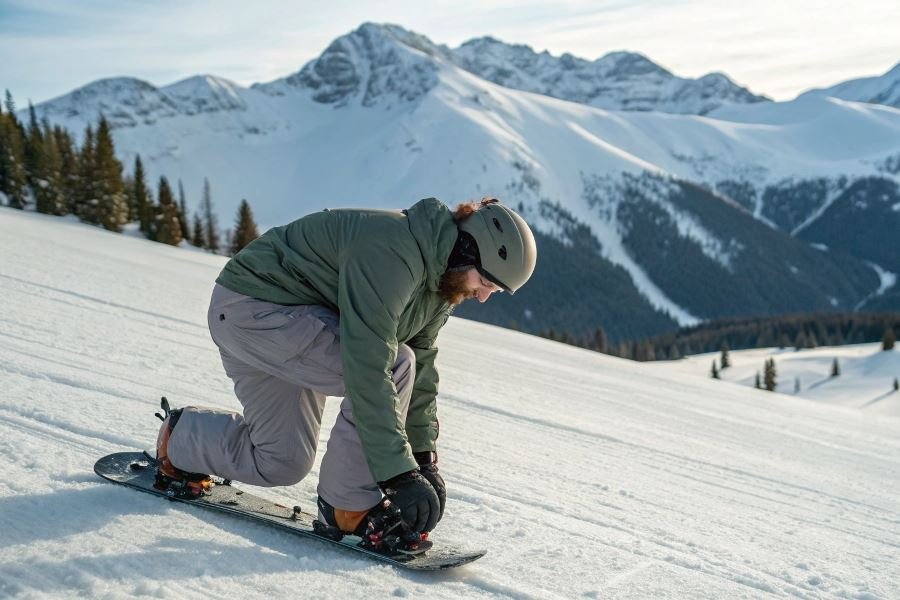
Ever watched a pro snowboarder effortlessly carve through powder while you struggle to maintain control? The secret might not be skill alone—it’s often in the bindings. Those seemingly simple mechanisms connecting your boots to your board can make the difference between floating down the mountain and face-planting in the snow.
When your bindings are properly adjusted, they become an extension of your body, translating every subtle shift in weight into precise board movement. When they’re not? You’re essentially driving with a loose steering wheel. Research from the American Orthopedic Society for Sports Medicine shows that improperly adjusted bindings contribute to nearly 30% of preventable snowboarding injuries.
The binding basics: What you’re working with
Your snowboard bindings consist of several key components: the baseplate (attaches to the board), highbacks (supports your calves), ankle straps, toe straps, and various adjustment mechanisms. Each element can be fine-tuned to match your riding style, stance preference, and physical build.
Tools of the trade
Before making any adjustments, gather these essentials:
- A quality #3 Phillips screwdriver (magnetic tip preferred)
- 4mm hex/Allen wrench
- Snowboard-specific multi-tool (worth the $25-35 investment)
- Small ruler or measuring tape
- Your snowboard boots (always adjust with the actual boots you’ll ride in)
The right tools prevent stripped screws and ensure precise adjustments that won’t loosen during your run. Remember: a binding that comes loose mid-ride isn’t just annoying—it’s dangerous.
Dialing In Your Snowboard Bindings Like a Pro
Getting your snowboard bindings dialed in perfectly isn’t just about comfort—it’s the foundation of your entire riding experience. The right setup can dramatically improve your control, reduce fatigue, and help you progress faster on the mountain. Let’s break down the step-by-step process of how to properly adjust the bindings on a snowboard so you can maximize your performance and enjoyment on the slopes.
Finding Your Natural Stance
First things first: are you regular (left foot forward) or goofy (right foot forward)? If you’re unsure, try these quick tests:
- Which foot do you naturally put forward when sliding on ice?
- If someone gently pushed you from behind, which foot would you step forward with?
- Which foot do you kick a ball with? (Your non-dominant foot typically goes forward)
Your stance is the foundation of your entire setup. Getting this wrong is like trying to write with your non-dominant hand—technically possible, but unnecessarily difficult!
Binding Angles That Match Your Style
Your binding angles should reflect how you ride:
| Riding Style | Front Foot Angle | Back Foot Angle |
|---|---|---|
| All-Mountain | +15° to +21° | 0° to +6° |
| Freestyle | +15° to +18° | -3° to -15° |
| Freeride | +18° to +24° | +3° to +9° |
| Beginner | +15° | 0° |
Directional setups (positive angles on both feet) provide more stability at speed, while duck stances (positive front, negative back) give better switch riding capability.
Nailing Your Stance Width
Your stance width should be approximately shoulder-width or slightly wider—typically 18-22 inches for most riders. Too narrow feels unstable; too wide reduces agility and increases fatigue.
Pro tip: Stand naturally with your knees slightly bent. The distance between your feet in this athletic position is your ideal starting point.
Centering Your Bindings
Proper board control requires your bindings to be centered across the width of your board:
- Measure the distance from binding edge to board edge on both toe and heel sides
- Adjust until these measurements are equal (or slightly toe-heavy for deeper carving)
- Check that both bindings are equally centered
An off-center stance can create unwanted leverage that makes edge transitions unpredictable and exhausting.
Highback Adjustments for Precision Control
Your highbacks deserve special attention:
-
Forward lean: More lean equals more responsive heelside turns but increased calf fatigue. Start with minimal lean (1-2 clicks) and adjust based on your riding style.
-
Highback rotation: Align your highbacks parallel to your board’s heel edge for optimal power transfer. Most Burton and Union bindings feature tool-free rotation adjustments.
Fine-Tuning Strap Fit
The perfect strap adjustment balances security with comfort:
- Ankle straps should sit centered on your boot
- Toe straps should either cap the toe or press down on the top of your foot (depending on design)
- You should be able to fit one finger between the strap and boot when fully tightened
Remember: Straps that are too loose waste energy; too tight restrict circulation and cause pain.
Take the time to dial in these adjustments before hitting serious terrain. A properly set up board responds like an extension of your body, while a poorly adjusted one fights you at every turn. The difference isn’t subtle—it’s the gap between frustration and flow state.
Fine-Tuning Your Snowboard Binding Setup Like a Pro
Dialing In Your Perfect Binding Adjustment
Testing your binding setup isn’t just important—it’s the difference between an average day and an epic session on the mountain. After your initial setup, take your board to a flat, safe area and simulate some basic movements. Feel for pressure points, responsiveness, and overall comfort. Your bindings should feel like a natural extension of your body, not a restriction.
Pro tip: Make micro-adjustments (1-2 degrees at a time) rather than dramatic changes. This methodical approach helps you pinpoint exactly what works for your riding style.
Many riders find their perfect setup through the “three-run test”:
- First run: Focus on how turns initiate
- Second run: Pay attention to stability at speed
- Third run: Test responsiveness in varied terrain
The binding setup that feels invisible is usually the right one—when you’re thinking about the snow beneath you rather than the equipment attached to your feet.
Binding Blunders That Sabotage Your Ride
Even experienced riders make these common binding adjustment mistakes:
| Mistake | Consequence | Quick Fix |
|---|---|---|
| Uneven stance width | Unbalanced riding, knee strain | Measure from center of each binding to ensure symmetry |
| Overtightened hardware | Reduced board flex, potential binding damage | Tighten until snug, then add 1/4 turn only |
| Mismatched angles | Awkward stance, reduced control | Ensure your angles complement your riding style |
| Ignoring highback rotation | Heel-edge response suffers | Align highbacks parallel to heel edge |
The most overlooked mistake? Inconsistent binding placement between sessions. Take photos of your preferred setup or mark your position with a permanent marker on the baseplate for quick reference.
Seasonal Binding Maintenance That Pays Off
Your bindings need love to perform their best. Implement these maintenance practices to extend their lifespan and performance:
-
Mid-season check: After every 5-7 riding days, inspect and tighten all hardware with a proper Burton snowboard tool or equivalent multi-tool.
-
Clean out snow and ice buildup from ratchets and ladders using compressed air or a soft brush—never metal tools that could scratch components.
-
Lubricate moving parts sparingly with silicone-based lubricant, especially on ratchet mechanisms and forward lean adjusters.
-
Store bindings loosened during off-season to prevent stress on straps and ratchets.
When to Reassess Your Binding Setup
Your perfect binding setup isn’t static—it evolves with your riding. Consider readjustment when:
- Your riding style changes (park to powder, for example)
- You experience new discomfort or fatigue
- After significant weight changes
- When switching between different boards
- After upgrading boots (new boots = new binding setup)
Advanced riders often maintain multiple setups: a more aggressive stance for carving days and a more centered, relaxed stance for park sessions. Don’t be afraid to experiment—the best riders constantly refine their setups based on conditions and objectives.
Remember that binding technology evolves rapidly. What worked on your Union bindings five years ago might not apply to today’s models with updated baseplates and strap designs.
Fine-tuning your binding setup is an ongoing relationship with your equipment—one that rewards attention to detail with better performance and more enjoyable days on the mountain.