
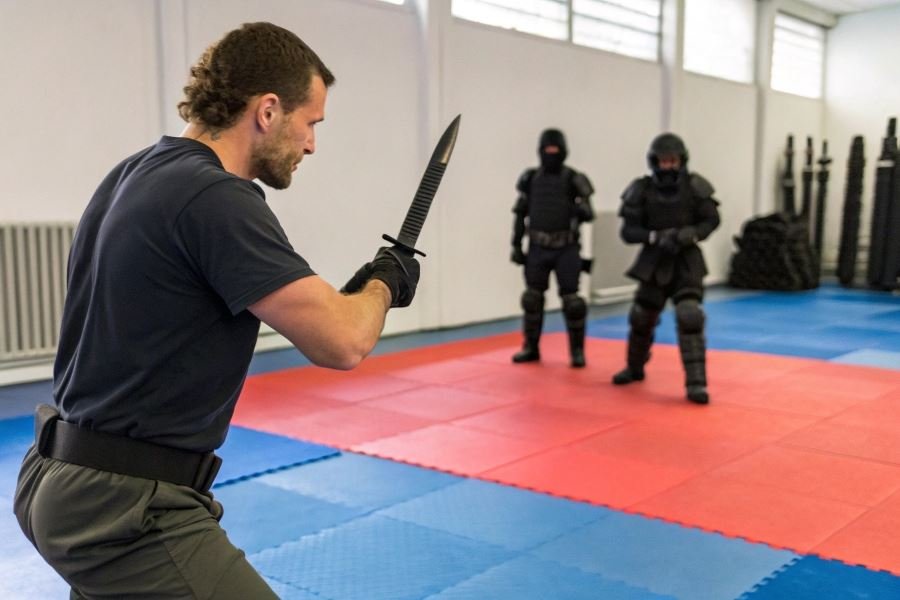
Ever watched someone practice martial arts with a real knife? Neither have I—because they’re still alive. Self-defense training with actual blades is like learning to swim in a shark tank: unnecessarily dangerous and potentially fatal. This is where training knives become not just useful, but essential.
Training knives have revolutionized how we approach defensive tactics since the early 2000s. These purpose-built tools mimic the weight, balance, and feel of actual combat knives while eliminating the lethal edge. The difference between practicing with the real thing versus a training knife can literally be life or death—making them indispensable for anyone serious about personal protection.
When selecting your ideal training knife, three critical features stand out: durability, realistic weight distribution, and appropriate material composition. The best training knives are crafted from materials like polypropylene or aluminum that can withstand thousands of practice strikes without degrading. They should balance like their lethal counterparts—typically with weight centered slightly forward of the handle—giving you authentic handling experience without the risk.
Safety first isn’t just a slogan—it’s the foundation of effective practice. Always maintain a designated training area with ample space, wear appropriate protective gear (especially eye protection), and establish clear communication protocols with training partners. Remember that even blunt training knives can cause injury when used improperly.
The right training knife doesn’t just protect your body during practice—it protects your development as a practitioner.
Training Knife Mastery: The Ultimate Guide to Self-Defense Practice Tools
When it comes to developing effective self-defense skills, proper training tools make all the difference between dangerous fumbling and confident execution. Training knives offer practitioners the ability to simulate real combat scenarios without the associated risks. After testing dozens of models across various training environments, I’ve identified the top 3 training knives for practicing self-defense that deliver exceptional performance, durability, and realistic handling characteristics.
Let’s dive into the specifics of each trainer that has earned its place in the elite circle of must-have practice tools for serious self-defense enthusiasts.
Cold Steel Rubber Training Knife: Indestructible Realism
The Cold Steel Rubber Training Knife stands as a testament to thoughtful design meeting practical application. Constructed from high-density rubber with a solid core, this trainer delivers:
Unmatched Durability: Even after thousands of training strikes, these knives show minimal wear. The proprietary rubber compound resists tearing while maintaining enough flexibility to prevent injury.
The texture provides just enough grip without being abrasive during extended drills, a crucial feature when training sessions extend beyond the one-hour mark.
Realistic Weight Distribution: At 3.2 ounces, the Cold Steel trainer mimics the heft of an actual tactical knife, creating muscle memory that translates directly to real-world applications.
Impact Feedback: The semi-rigid construction provides tactile feedback during contact, allowing practitioners to gauge the effectiveness of strikes without risking injury to training partners.
| Feature | Specification | Benefit |
|---|---|---|
| Material | High-density rubber | Safe impact, realistic feel |
| Weight | 3.2 oz | Authentic handling |
| Length | 7.5 inches | Matches common tactical knives |
| Price | $19.99 | Accessible for all training levels |
Benchmade Training Knife: Precision Engineering
The Benchmade Training Knife represents the gold standard in high-fidelity training implements. This trainer excels in:
Balance Perfection: Engineered with the exact same balance point as Benchmade’s combat models, this trainer creates muscle memory that transfers seamlessly to live blades.
Ambidextrous Design: The thoughtfully crafted handle accommodates both right and left-handed users with equal comfort, featuring textured G10 scales that provide positive grip even with sweaty hands.
The precision-machined aluminum “blade” features rounded edges that won’t cut skin but will leave a temporary mark on clothing, providing visual feedback on strike accuracy.
Deployment Mechanics: Unlike many trainers, the Benchmade includes fully functional opening mechanisms identical to their tactical counterparts, allowing practitioners to practice deployment under stress.
CRKT Folts Minimalist Trainer: Compact Versatility
The CRKT Folts Minimalist Trainer proves that effective training doesn’t require bulky equipment. This compact trainer delivers:
Concealment Practice: At just 5.13 inches overall and weighing a mere 1.6 ounces, this trainer allows practitioners to develop skills with a tool that matches the profile of everyday carry knives.
Ergonomic Mastery: The full-tang construction features a resin-infused fiber handle with deep finger grooves that lock the knife into your grip during dynamic movement.
Multiple Carry Options: Includes a glass-reinforced nylon sheath with adjustable paracord that can be configured for neck carry, belt mounting, or attachment to tactical gear.
Realistic Draw Training: The retention system in the sheath requires the same draw technique as the live version, building critical muscle memory for emergency situations.
Each of these trainers offers distinct advantages depending on your training goals, physical attributes, and preferred defensive style. Incorporating all three into your practice regimen provides the most comprehensive preparation for real-world self-defense scenarios.
Maximizing Your Self-Defense Training with Training Knives
The difference between theoretical knowledge and practical skill in self-defense is measured in milliseconds—milliseconds that could save your life. Training knives bridge this gap, transforming abstract concepts into muscle memory. Let’s dive into how these tools can revolutionize your self-defense practice.
Drills that develop real-world reflexes
The beauty of training knives lies in their versatility. Start with the foundation: the basic defensive stance. Feet shoulder-width apart, knees slightly bent, training knife held in your dominant hand at mid-torso level. From here, three essential drills form your practice backbone:
-
Defensive blocking patterns – Practice the four quadrants (high inside, high outside, low inside, low outside) against a partner’s attacks. Begin at 25% speed, gradually increasing as your confidence grows.
-
Distance management exercises – Work with a partner to maintain the critical “reactionary gap”—approximately 4-6 feet. When they advance, you retreat while maintaining your defensive posture; when they retreat, you advance.
-
Disarm techniques – Perhaps the most advanced drill, focusing on safely neutralizing an attacker’s weapon. The “redirect and control” technique has proven particularly effective in real-world scenarios.
“Perfect practice makes perfect performance. Train with intention, not just repetition.”
For maximum benefit, incorporate these drills into 15-minute daily sessions rather than sporadic hour-long practices. Consistency builds neural pathways that activate during high-stress situations.
Integrating knives into comprehensive defense systems
Training knives don’t exist in isolation—they’re part of a holistic self-defense approach. The most effective training regimens integrate knife defense with:
Empty-hand techniques: Your Krav Maga or Filipino Martial Arts training provides the foundation. Training knives enhance these systems by adding weapon awareness.
Environmental awareness: Practice scenarios in different settings—confined spaces, low light, multiple directions. Your training environment should gradually approximate real-world complexity.
Stress inoculation: Introduce controlled stress elements into your training. Simple additions like timer pressure or having observers can elevate your heart rate, simulating the physiological effects of a real encounter.
| Defense System | Training Knife Integration Point | Key Benefit |
|---|---|---|
| Krav Maga | Threat neutralization | Direct counter-attack skills |
| Filipino Martial Arts | Flow drills | Fluid response to changing threats |
| RBSD (Reality-Based Self Defense) | Scenario training | Contextual application |
The progression path to mastery
Self-defense knife training follows a clear developmental trajectory:
Beginner phase (1-3 months): Focus on grip fundamentals, basic defensive postures, and simple evasion techniques. At this stage, slow-motion practice with a partner builds proper form without developing bad habits.
Intermediate phase (3-12 months): Introduce variable speeds, combination techniques, and counter-attacks. Your training should now include “flow drills” where attacks and defenses happen in continuous motion.
Advanced phase (12+ months): Incorporate multiple attackers, environmental challenges, and stress-inducing elements. Advanced practitioners can handle complex scenarios while maintaining tactical awareness.
The progression isn’t just about techniques—it’s about developing the psychological resilience to remain calm under pressure. Training knives allow you to simulate high-threat scenarios safely, building both physical skills and mental fortitude.
Remember: effective self-defense isn’t about looking impressive; it’s about going home safely. Training knives provide the perfect balance of realism and safety to develop skills that work when they matter most.