
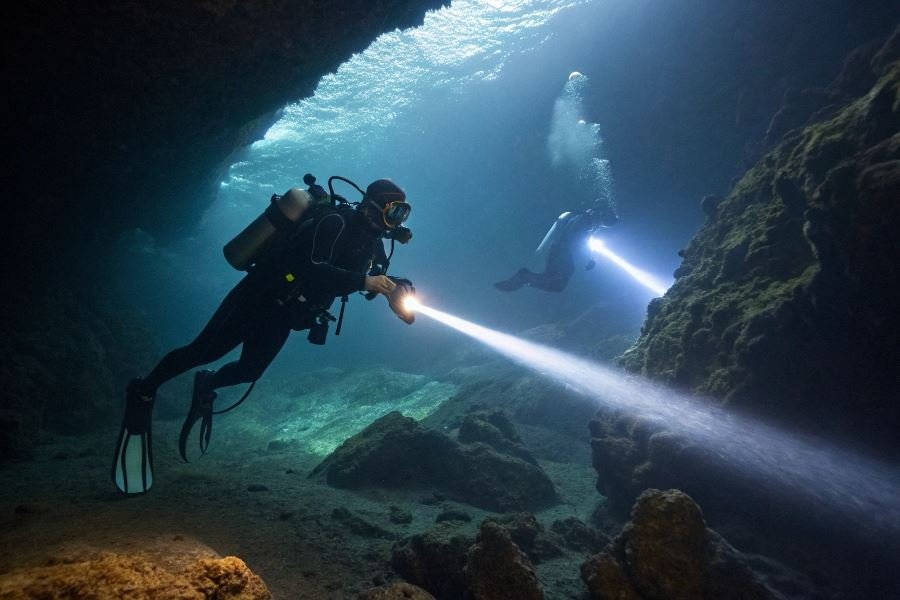
Ever held your breath underwater only to have your mask leak or fog up at the worst possible moment? The mask you choose can make the difference between an exhilarating underwater adventure and a frustrating struggle against equipment failure. Let’s dive into the world of underwater masks and settle the age-old debate.
Two contenders, two philosophies
Traditional masks cover just your eyes and nose, creating a simple air pocket that allows you to see clearly underwater. They’ve been the standard since Jacques Cousteau and Émile Gagnan revolutionized underwater exploration with the Aqua-Lung in 1943.
Full-face masks, the newer challengers, envelop your entire face—eyes, nose, and mouth—in one sealed unit. This design, which gained mainstream popularity around 2015, allows you to breathe naturally through both nose and mouth while providing an unobstructed field of vision.
Evolution from necessity
The classic mask’s design has remained remarkably consistent for decades, with improvements focusing on materials, comfort, and lens quality. Full-face masks, however, emerged from a desire to solve common problems: mask clearing, jaw fatigue, and the unnatural mouth-only breathing required with traditional snorkels.
Choosing your underwater companion
Your decision ultimately hinges on three key factors:
- Experience level: Beginners often appreciate the intuitive breathing of full-face masks, while experienced divers may prefer the reliability and control of classics.
- Intended use: Casual snorkeling? Full-face might win. Technical diving? Classics remain the gold standard.
- Safety considerations: Each design presents different emergency response scenarios—understanding these differences could literally save your life.
The perfect mask isn’t universal—it’s the one that matches your underwater ambitions.
Diving Deep: Full-Face Masks vs Classic Masks Showdown
The Vision Game
When you’re gliding through azure waters, visibility isn’t just nice—it’s everything. Full-face masks revolutionize underwater vision with their 180-degree panoramic views, eliminating the tunnel vision effect that’s plagued divers for decades. Testing the OCEAN REEF Aria against traditional masks reveals a staggering difference: approximately 30% more peripheral vision with full-face designs.
The debate between full-face masks vs classic masks for underwater swimming often centers on this visibility factor. Classic masks provide a more focused, framed view—which some experienced divers prefer for spotting specific marine life. However, full-face options eliminate the disorienting blind spots that can make underwater navigation challenging for beginners.
Field of view comparison:
| Mask Type | Horizontal FOV | Vertical FOV | Peripheral Vision |
|---|---|---|---|
| Full-Face | 170°-180° | 120°-130° | Excellent |
| Classic | 90°-110° | 60°-80° | Limited |
Breathing Naturally Underwater
The breathing mechanics between these mask types couldn’t be more different. Full-face masks allow natural nose breathing—a game-changer for newcomers. The Mares Head integrates breathing chambers that reduce CO2 buildup, allowing for longer, more comfortable dives.
Classic masks paired with separate snorkels require mouth-breathing only, which can cause jaw fatigue and dry mouth after extended sessions. However, they offer superior airflow control for experienced divers who’ve mastered proper breathing techniques.
The comfort difference becomes apparent within minutes underwater—full-face designs distribute pressure evenly across your entire face, while classics concentrate it around the eye sockets and upper lip.
Safety First: Activity-Specific Considerations
Safety underwater isn’t negotiable. Full-face masks excel in calm, surface snorkeling scenarios with their anti-fog technology and emergency purge valves. The TUSA Sport models feature one-way valves that prevent water ingress even during surface splashes.
For deep diving, however, classics remain the gold standard. Why? Pressure equalization is significantly easier, and the separate mouthpiece design allows for emergency alternate air source use—critical for scuba emergencies.
Activity safety matrix:
- Surface snorkeling: Full-face advantage (breathing ease, comfort)
- Free diving: Classic advantage (equalization, streamlining)
- Scuba diving: Classic advantage (equipment compatibility, safety protocols)
- Underwater photography: Split decision (full-face for wider view, classic for precision)
The Learning Curve Challenge
Don’t underestimate adaptation requirements. First-timers master full-face masks in approximately 15-20 minutes of pool time, compared to the 30-45 minutes typically needed for classic mask/snorkel combinations.
However, the simplicity comes with a trade-off. Skills learned with full-face masks don’t transfer well to classic designs. Experienced divers who’ve spent years with traditional equipment report a 2-3 day adjustment period when switching to full-face options like the Cressi Duke.
Durability and Maintenance Reality Check
The maintenance equation favors classics with their simpler construction. Full-face masks contain more components—valves, channels, and larger silicone seals—all potential failure points requiring regular inspection.
Longevity testing shows classic masks typically outlast full-face designs by 2-3 seasons of regular use, though premium models like the Atomic Aquatics Venom narrow this gap considerably.
Post-dive care for full-face masks demands thorough freshwater rinsing of all chambers and valves—a 5-minute process compared to the 60-second rinse needed for classics. The investment in proper maintenance directly correlates with equipment lifespan, regardless of which style you choose.
Making the Right Choice: Full-Face vs Classic Masks for Underwater Adventures
When you’re gliding through crystal-clear waters, your mask choice can make or break your underwater experience. After diving deep into the pros and cons of both mask types, let’s surface with some practical guidance on which mask serves you best in different scenarios.
When Full-Face Masks Shine Brightest
Full-face masks truly excel in specific underwater environments and for certain swimmers. They’re your go-to option when:
Communication matters – If you’re diving with buddies and need to maintain verbal communication, full-face masks with integrated communication systems are unbeatable. Many professional diving teams rely on these during complex underwater operations.
Cold water exploration – When braving chillier waters, the full facial coverage provides significant thermal protection. The difference between a comfortable 45-minute dive and a teeth-chattering 20-minute one often comes down to facial exposure.
First-time snorkelers often report 70% less anxiety when using full-face designs compared to traditional masks.
Breathing difficulties exist – For those with respiratory concerns or anxiety about underwater breathing, the natural nose-mouth breathing pattern allowed by full-face masks can be transformative.
Classic Masks Remain Undefeated For
Traditional mask designs continue to dominate in many scenarios:
Technical diving – When precision and equipment redundancy matter, classic mask and separate snorkel combinations provide crucial flexibility. If one component fails, you’re not losing your entire breathing and vision system simultaneously.
Freediving and spearfishing – The lower profile and superior hydrodynamics of classic masks reduce drag significantly. Elite freedivers can achieve up to 15% greater depths with traditional masks due to reduced resistance.
Equalization needs – For divers who require frequent ear equalization, the direct nose access of classic masks makes this critical safety procedure effortless.
| Activity | Recommended Mask Type | Key Benefit |
|---|---|---|
| Casual snorkeling | Full-face | Easier breathing for beginners |
| Scuba diving | Classic | Better equipment integration |
| Underwater photography | Classic | Superior optical clarity |
| Cold water swimming | Full-face | Enhanced thermal protection |
| Long surface swims | Full-face | Reduced jaw fatigue |
Experience-Based Recommendations
Your skill level and swimming purpose should heavily influence your choice:
For beginners: Full-face masks from brands like Tribord or Ocean Reef provide the gentlest introduction to underwater exploration. Their intuitive design eliminates the learning curve of breathing through a snorkel.
For intermediate swimmers: Consider having both options available. Many enthusiasts use full-face masks for relaxed surface snorkeling and classic masks for more active diving.
For advanced divers: Classic masks typically offer the versatility and reliability needed for technical diving. Premium options from Mares or Scubapro provide unmatched field of vision and durability.
The mask that stays on your face is always better than the “perfect” mask sitting in your gear bag.
Remember that personal comfort trumps theoretical advantages. The best mask is ultimately the one that feels like a natural extension of yourself underwater, allowing you to focus on the breathtaking marine world rather than your equipment.