
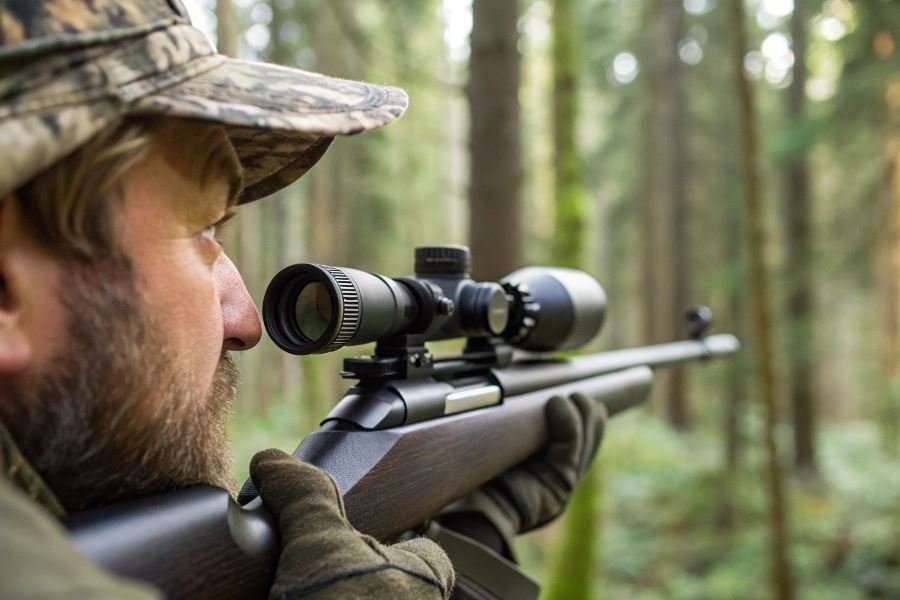
Ever stood 300 yards from a trophy elk, heart pounding, only to miss the shot because your scope couldn’t deliver when it mattered most? That moment—that crushing disappointment—is exactly why serious hunters obsess over their optics.
When the difference between success and failure comes down to seconds, your scope becomes the most critical link between you and your target. The right glass doesn’t just improve accuracy—it fundamentally transforms your hunting experience. A premium scope turns challenging shots into ethical harvests, while the wrong one turns perfect opportunities into stories about “the one that got away.”
“The scope you choose determines not just if you hit your target, but how you hit it. Ethical hunting demands precision that only proper optics can deliver.”
Your scope selection impacts three critical dimensions of the hunt:
- Shot placement precision – The difference between a clean, humane harvest and a wounded animal that suffers unnecessarily
- Environmental adaptability – How your optics perform in low light, harsh weather, and varying terrain
- Functional reliability – Whether your investment will maintain zero through recoil, rough handling, and years of field use
Understanding these three pillars of scope selection isn’t just about equipment—it’s about respecting the hunt, the animal, and the tradition. The perfect scope doesn’t exist, but the perfect scope for your specific hunting situation absolutely does. Let’s explore how to find it.
Optical Excellence for Big Game Success
When stalking elk across mountain valleys or waiting for that trophy buck, your scope becomes your most critical ally. The difference between a clean ethical kill and a miss often comes down to your optics. Let’s dive into the essential optical criteria for choosing a scope for big game hunting that will serve you in those heart-pounding moments when everything is on the line.
Magnification That Matches Your Hunt
The perfect magnification depends entirely on your hunting environment and typical shooting distances. For dense forest hunting where shots rarely exceed 100 yards, a fixed 4x scope or a 1-4x variable provides quick target acquisition without excessive magnification that can limit your field of view.
Medium-range hunters working agricultural edges or open woodlands should consider 3-9x or 2-10x variables. These versatile ranges handle both close surprise encounters and calculated 200-300 yard shots with equal precision.
For western hunters glassing across canyons or plains hunters expecting shots beyond 300 yards, higher magnification becomes essential. A 4-16x or even 5-25x scope gives you the ability to identify and accurately place shots on distant targets. Remember that higher magnification amplifies every tiny movement, so stability becomes increasingly important.
| Hunting Environment | Typical Distance | Recommended Magnification |
|---|---|---|
| Dense Forest | 25-100 yards | 1-4x or Fixed 4x |
| Mixed Woodland/Field | 100-300 yards | 3-9x or 2-10x |
| Open Country | 300+ yards | 4-16x or 5-25x |
Light Gathering Capabilities
The objective lens diameter directly impacts how much light your scope can gather – critical during the prime hunting hours of dawn and dusk. When evaluating criteria for choosing a scope for big game hunting, light transmission should be near the top of your list.
A larger objective lens (measured in millimeters) allows more light to enter the scope. A 40mm objective provides adequate light gathering for most hunting situations, while 50mm or larger objectives excel in low-light conditions. However, larger objectives require higher mounting, potentially affecting your cheek weld and quick shouldering.
Light transmission percentage is equally important. Premium scopes from manufacturers like Leupold or Swarovski often transmit 90%+ of available light through superior glass quality and lens coatings. Budget scopes might only transmit 70-80%, making the difference between seeing your target clearly or losing it in the shadows.
Reticle Selection for Hunting Success
Your reticle choice can dramatically impact your hunting effectiveness across different scenarios. The traditional duplex reticle remains popular for its simplicity and quick target acquisition, especially in timber or brush country where shots happen fast.
For longer-range hunting, ballistic reticles like the Vortex EBR or Nikon BDC provide holdover points for different distances, eliminating guesswork when compensating for bullet drop. These are invaluable when hunting across varied terrain where distances change rapidly.
Illuminated reticles shine in low-light conditions, particularly the red dot or illuminated crosshair varieties. They provide contrast against dark-bodied game in heavy timber or during the last minutes of legal shooting light. However, battery dependence introduces a potential point of failure in remote hunting situations.
First-focal-plane reticles maintain their size relationship to the target throughout the magnification range, making them ideal for hunters who need to range and shoot quickly at various distances. Second-focal-plane options keep the reticle visually consistent regardless of magnification, preferred by hunters who value simplicity and consistent sight pictures.
Your optical choices directly influence your hunting success. By matching magnification to your environment, prioritizing light transmission, and selecting the appropriate reticle for your hunting style, you’ll be equipped to make ethical, confident shots when that once-in-a-lifetime trophy steps into view.
Making the Perfect Match: Your Big Game Scope Selection Guide
The critical factors that truly matter
When selecting a scope for big game hunting, the culmination of your research should focus on several non-negotiable factors. Magnification range, objective lens diameter, and reticle type form the technical trinity of your decision. A 3-9x40mm configuration remains the gold standard for versatility, while premium options like the Leupold VX-5HD offer exceptional light transmission for those crucial dawn and dusk hunts. The durability trifecta—waterproofing, fogproofing, and shockproofing—separates reliable performers from disappointments when facing harsh field conditions.
Eye relief deserves special attention for hunters using high-recoil calibers like .300 Win Mag or .338 Lapua. A minimum of 3.5 inches prevents the dreaded “scope eye” injury that can ruin a hunt and leave you with an unwelcome souvenir.
Matching your glass to your hunting grounds
Different hunting environments demand specialized optics solutions:
| Hunting Environment | Recommended Scope Specifications | Example Model |
|---|---|---|
| Dense Forest | 1-6x variable, illuminated reticle, 30mm tube | Vortex Razor HD Gen II |
| Open Plains | 4-16x magnification, BDC reticle, 50mm objective | Nikon Monarch |
| Mountain Terrain | 3-15x, lightweight design, turret locks | Zeiss Conquest V4 |
| Mixed Terrain | 2-10x, versatile reticle, side focus | Swarovski Z5 |
For those hunting in the timber of the Pacific Northwest, prioritize quick target acquisition and brightness over extreme magnification. Conversely, western hunters glassing across canyons need higher magnification and superior glass quality to identify trophy animals at extreme distances.
The perfect scope for Montana’s open ranges might be completely wrong for Alabama’s dense hardwoods.
Balancing investment with performance
The final consideration in your scope selection comes down to the intersection of budget, durability, and satisfaction. While premium scopes from manufacturers like Schmidt & Bender can exceed $3,000, excellent performance can be found in the $500-1,000 range from brands like Vortex and Leupold.
Your scope investment should align with both your rifle’s quality and your hunting frequency. A $2,000 scope on a $400 rifle creates an imbalance, while a budget scope on a custom rifle limits the system’s potential.
The warranty factor
The best scope is the one that stays zeroed when you need it most, regardless of what you paid for it.
Many manufacturers now offer lifetime, transferable warranties that provide peace of mind for your investment. Vortex Optics pioneered this approach with their VIP warranty, and many competitors have followed suit.
Final field advice: Purchase the best scope your budget allows, but never compromise on optical clarity, mechanical reliability, or warranty coverage. A quality scope purchased once will serve faithfully through decades of hunts, while a bargain-basement option might fail at the moment of truth. Your scope is the critical link between you and your trophy—invest accordingly.