
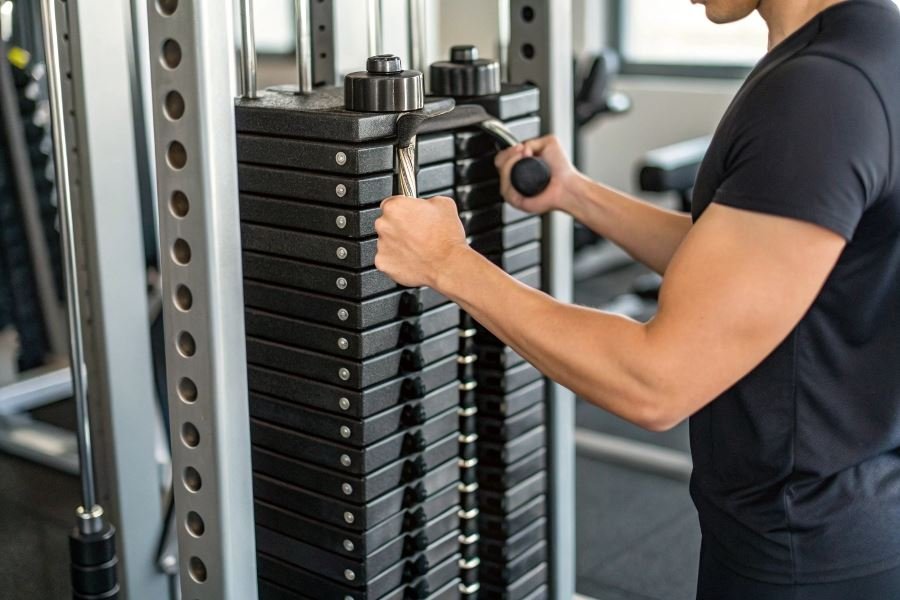
Ever stood in a gym surrounded by towering machines, each promising the body of your dreams, and thought, “Which one actually delivers?” You’re not alone. The right weight machine can transform your fitness journey—the wrong one might collect more dust than sweat.
Weight machines with built-in resistance systems have revolutionized home and commercial gyms since Nautilus first introduced their cam-based machines in the 1970s. Today’s options range from compact cable systems to comprehensive multi-stations that target every muscle group imaginable. But here’s the truth: the “best” machine depends entirely on what you’re trying to accomplish.
When comparing built-in weight machines to traditional free weights, several advantages emerge. First, machines provide guided movement patterns that reduce injury risk—particularly valuable for beginners or those rehabilitating injuries. They also allow for isolated muscle targeting that’s difficult to achieve with dumbbells alone. Perhaps most importantly, weight machines enable progressive overload with precise increments, letting you track improvements down to the pound.
The machine landscape breaks down into several categories:
- Plate-loaded machines: Offering the feel of free weights with guided movement
- Selectorized systems: Featuring weight stacks with simple pin adjustments
- Cable machines: Providing constant tension throughout movements
- Functional trainers: Allowing multi-directional resistance for sport-specific training
Your fitness objectives should drive your selection process. Building mass? Look for machines with substantial weight capacity and compound movement patterns. Rehabilitation? Prioritize smooth resistance curves and adjustable ranges of motion. Limited space? Consider multi-function units that pack several exercises into a smaller footprint.
Key Factors for Choosing Your Perfect Weight Machine
Finding the right machine with built-in weights isn’t just about picking the shiniest equipment in the catalog—it’s about matching hardware to your fitness DNA. Let’s dive into what truly matters when selecting a weight machine that will transform your home gym from a storage space into your personal strength sanctuary.
Match Machines to Your Fitness Mission
The journey to selecting the ideal weight machine begins with brutal honesty about your goals. Are you chasing strength gains that’ll let you open stubborn pickle jars with ease? Looking to build muscle definition that turns heads at the beach? Or perhaps you’re after endurance that keeps you moving when others quit?
For pure strength development, prioritize machines with built-in weights that offer progressive overload capabilities—systems like the Bowflex Revolution with its SpiraFlex technology or the Force USA G20 that can handle serious poundage. Hypertrophy hunters should seek machines with smooth resistance curves and isolation capabilities, while endurance athletes benefit from systems allowing quick transitions between exercises.
Space: The Final Frontier
Your dream machine means nothing if it won’t fit in your space. Measure twice, buy once—this isn’t just carpenter wisdom, it’s home gym gospel.
Most all-in-one weight machines require:
- Ceiling clearance: 7-8 feet minimum
- Footprint: 4×6 to 7×8 feet for operation
- Buffer zone: 2-3 feet around all sides for safe movement
| Machine Type | Footprint (ft) | Ceiling Height (ft) | Folding Option |
|---|---|---|---|
| Compact Stack | 4×6 | 7 | Rarely |
| Full Smith/Cable | 6×8 | 8+ | No |
| Functional Trainer | 5×5 | 7.5 | Sometimes |
Remember that corner placement can save space, but may limit range of motion for certain exercises. Many manufacturers like NordicTrack now offer VR previews to visualize machines in your space before purchase.
Weight Range: From Beginners to Beasts
Nothing kills progress faster than outgrowing your equipment. The weight range should accommodate both your current strength level and your future potential.
Entry-level machines typically offer 150-210 pounds of resistance, while mid-range options push to 300+ pounds. Elite systems from Tonal provide digital resistance up to 200 pounds per arm with adaptive technology that grows with you.
The resistance mechanism matters tremendously:
- Weight stacks: Familiar, reliable, but limited by included plates
- Power rods: Compact, progressive resistance, but may lose tension over time
- Plate-loaded: Unlimited potential, but requires separate weight purchases
- Digital/magnetic: Smooth, quiet, precise, but typically more expensive
Adjustability: The Versatility Factor
The best machines transform faster than a superhero in a phone booth. Look for:
- Multiple seat/bench positions (minimum 5)
- Adjustable pulley heights (at least high, mid, low)
- Quick-change mechanisms for resistance levels
- Convertible stations for different exercise types
Machines like the Life Fitness G7 offer dual adjustable pulleys with 19 height settings, creating virtually unlimited exercise possibilities from a single footprint.
Built to Last: Quality Considerations
A weight machine is an investment, not an impulse buy. Frame construction should feature heavy-gauge steel (11-gauge or better) with quality welds and reinforced stress points. Cable systems should use aircraft-grade cables rated for at least 2000-pound breaking strength.
Warranty terms tell you how much manufacturers trust their own products:
- Frame: Should be lifetime
- Parts: 3-5 years minimum
- Labor: 1-2 years
- Wear items: 90 days to 1 year
The Hoist V6 exemplifies premium construction with commercial-grade components that transition seamlessly to home use, backed by comprehensive warranties that protect your investment for years of serious training.
By methodically evaluating these factors against your specific goals, you’ll find a machine with built-in weights that doesn’t just occupy space in your home—it becomes the cornerstone of your fitness journey.
The Ultimate Machine Arsenal: Choosing Built-in Weight Systems for Your Fitness Goals
Multi-functional home gyms for total body transformation
When space efficiency meets workout versatility, you get the modern multi-functional home gym. These engineering marvels pack an entire fitness center’s worth of exercises into a footprint that fits comfortably in your spare room.
The Bowflex Revolution exemplifies this category with its SpiraFlex technology, offering up to 220 pounds of resistance without the actual weight plates. What makes these systems revolutionary is their ability to transition between exercises in seconds—no plate changing, no waiting.
Key advantages of multi-functional systems:
- Over 60 exercises from a single station
- Resistance that feels like free weights but with smoother transitions
- Space-saving design (typically 7’×8’ footprint or smaller)
- Safety features for solo training
Most multi-functional gyms use either weight stacks, power rods, or resistance plates. The Life Fitness G7 employs a traditional weight stack system that serious lifters find more intuitive, while systems like the Total Gym FIT use your body weight plus incline to create resistance.
The best multi-functional gyms allow you to perform compound movements like chest press, rows, and leg extensions with minimal adjustment time between exercises.
Cable machines for functional strength mastery
Cable machines represent the sweet spot between isolation work and functional movement patterns. Unlike fixed-path machines, cables allow three-dimensional movement that mimics real-world activities.
The Keiser Functional Trainer stands out with its pneumatic resistance system that maintains consistent tension throughout the entire range of motion—a game-changer for rehabilitation and sports-specific training.
Why cable systems excel:
- Constant tension throughout movement arcs
- Adjustable pulley heights for targeting specific muscle angles
- Ideal for rotational movements that fixed machines can’t replicate
- Superior for unilateral (single-side) training to address imbalances
Cable machines particularly shine for shoulder rehabilitation and core training. The dual-pulley systems like the FreeMotion Dual Cable Cross allow for movements that engage stabilizing muscles often neglected in traditional strength training.
Smith machines and power racks for raw strength development
For those pursuing serious strength gains, Smith machines and power racks remain the gold standard. These systems combine the safety of built-in weight machines with the progressive overload potential of free weights.
The Rogue Monster Power Rack represents the pinnacle of this category, offering a modular design that can be customized with various attachments as your strength evolves.
Strength system advantages:
- Maximum load capacity (typically 600-1000+ pounds)
- Built-in safety mechanisms for heavy lifting without a spotter
- Versatility for both barbell and cable exercises
- Structural stability for explosive movements
Smith machines like the Matrix Ultra Smith Machine feature counterbalanced bar systems that reduce the effective weight of the bar itself, allowing for more precise loading. This makes them particularly valuable for beginners learning proper form or advanced lifters pushing their limits.
Power racks with integrated cable systems offer the best of both worlds—free weight training for compound movements and cable options for accessory work. The Force USA G12 exemplifies this hybrid approach with its all-in-one design that includes a Smith machine, power rack, and functional trainer.
When selecting your strength system, consider ceiling height requirements (typically 7-8 feet minimum) and floor reinforcement needs for heavier setups.