
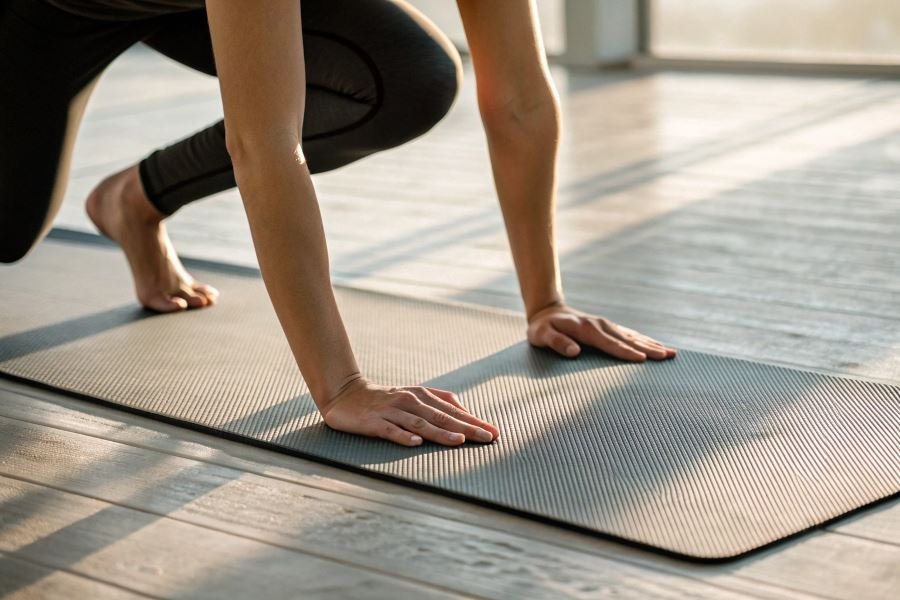
Ever stood on a borrowed yoga mat that felt like a slip-and-slide during downward dog? Or one so thin your knees screamed in protest during low lunges? The right mat isn’t just an accessory—it’s the foundation of your entire practice.
When beginning your yoga journey, the mat you choose can dramatically influence your experience, confidence, and progress. Think of it as the difference between running in proper athletic shoes versus flip-flops—both technically get the job done, but one path leads to enjoyment while the other leads to frustration (and possibly injury).
Why your mat choice matters more than you think
Your yoga mat serves as your personal island during practice—a dedicated space where balance, strength, and mindfulness develop. For beginners especially, the right mat provides crucial stability when attempting new poses and builds confidence as you explore your capabilities.
Grip matters. A mat with proper traction prevents slipping during poses like Warrior II or Triangle, allowing you to focus on form rather than fighting to stay upright.
Support is essential. The cushioning between you and the floor protects your joints during weight-bearing poses, particularly important if you have sensitive knees or wrists.
Finding your perfect match
Your ideal yoga mat depends on several factors unique to you:
- Practice style – Will you be doing gentle stretching or more vigorous vinyasa flows?
- Body sensitivity – Do your joints need extra cushioning?
- Practice environment – Will you practice at home, outdoors, or in heated studios?
- Portability needs – Will you travel with your mat or keep it in one location?
Remember that your needs may evolve as your practice deepens, but starting with a mat that addresses your immediate concerns creates the supportive foundation every beginner deserves.
Material Matters: The Foundation of Your Yoga Journey
When stepping onto the path of yoga, your mat becomes your sanctuary—the literal foundation upon which your practice builds. Selecting the right yoga mat as a beginner involves understanding the crucial interplay between materials, thickness, and texture that can either support or hinder your progress.
PVC vs TPE vs Natural Rubber: The Material Showdown
The material of your yoga mat dramatically affects everything from durability to eco-friendliness. For beginners learning how to choose a yoga mat for beginners, this decision deserves careful consideration.
PVC (Polyvinyl Chloride) mats dominate the market for good reason:
- Pros: Exceptional durability (can last 5+ years), excellent grip when dry, budget-friendly ($15-40), and resistant to wear
- Cons: Not biodegradable, may contain phthalates, and can have an initial chemical odor
TPE (Thermoplastic Elastomer) offers a middle ground:
- Pros: Recyclable, lightweight, closed-cell structure prevents bacteria growth, moderate price point ($25-60)
- Cons: Less durable than PVC (2-3 year lifespan), may stretch over time, less grip when sweaty
Natural Rubber appeals to the environmentally conscious:
- Pros: Superior grip even when wet, biodegradable, exceptional durability, antimicrobial properties
- Cons: Higher price ($60-120), heavier to carry, potential latex allergies, distinct rubber smell
Finding Your Perfect Thickness
The thickness of your mat directly impacts stability and comfort:
| Thickness | Best For | Considerations |
|---|---|---|
| Thin (1/16″ – 1/8″) | Balancing poses, Travel | Less cushioning, Better stability, Lightweight |
| Standard (1/8″ – 1/4″) | Most beginners, General practice | Good balance of cushioning and stability |
| Thick (1/4″ – 1/2″) | Restorative yoga, Joint issues | Maximum comfort, Reduced stability in balancing poses |
For beginners, the sweet spot typically falls in the standard range (3-5mm). This provides enough cushioning to protect knees and wrists without compromising stability in standing poses. If you’re practicing primarily gentle or restorative yoga, consider the thicker options for added comfort during longer holds.
Grip and Texture: The Unsung Heroes
Nothing disrupts flow faster than slipping during downward dog. The texture and grip of your mat can make or break your practice:
Raised patterns offer mechanical traction that works regardless of sweat levels. Look for geometric patterns that create multiple contact points with your skin.
Surface treatments on mats like those from Manduka or Lululemon provide grip that actually improves when slightly damp—perfect for beginners who might sweat from the effort of learning new poses.
Open-cell technology absorbs moisture rather than repelling it, maintaining grip during sweaty sessions. These mats require more cleaning but provide consistent performance.
The ideal texture should feel comfortable against your skin while providing enough friction to hold poses confidently. Too smooth, and you’ll slip; too rough, and sensitive palms may become irritated.
Remember that grip often improves after breaking in your mat through regular use. Many experienced practitioners swear by the “ugly mat” principle—those well-worn mats with perfect grip earned through hundreds of sun salutations.
Your mat is more than equipment; it’s your dedicated space for transformation. Choose wisely, and it will support every wobble, stretch, and breakthrough on your yoga journey.
Making Your Final Yoga Mat Decision: What Really Matters
Finding your perfect yoga mat isn’t just about following trends—it’s about making a choice that supports your practice for years to come. Let’s cut through the noise and focus on what truly matters when finalizing your decision.
Smart budget planning that pays off
The yoga mat market spans from $15 basics to $140+ premium options. While budget constraints are real, consider this: a quality mat that costs $60-80 typically outlasts three $20 mats. That initial investment often translates to better grip, comfort, and durability—elements that directly impact your practice quality.
Wisdom for the wallet: The true cost of a yoga mat isn’t the price tag—it’s the price divided by years of use.
First-timers might consider the middle ground: a $40-60 mat offers substantial improvements over entry-level options without requiring premium pricing. Brands like Gaiam frequently offer sales that bring quality mats into this accessible range.
Maintenance reality check
Your relationship with your mat extends beyond practice sessions. Different materials demand different care:
PVC mats: Wipe down with mild soap solution after sweaty sessions; deep clean monthly.
Natural rubber mats: Require gentle cleaners (no harsh chemicals); avoid prolonged sun exposure.
TPE/eco-friendly mats: Generally easier to maintain but may require more frequent replacement.
Consider your lifestyle honestly. If you know deep cleaning isn’t happening regularly, prioritize materials that forgive neglect. Most quality mats now include antimicrobial properties that prevent odor development—a feature worth the extra dollars for busy practitioners.
Top beginner mats that deliver results
After testing dozens of options and consulting with yoga instructors, these three mats consistently outperform the competition for beginners:
| Mat | Best For | Key Features | Price Range |
|---|---|---|---|
| Manduka PRO Lite | Long-term investment | Lifetime guarantee, closed-cell surface, exceptional durability | $80-100 |
| Jade Harmony | Natural grip | Open-cell natural rubber, excellent traction, eco-friendly | $70-85 |
| Lululemon Take Form | Alignment guidance | Visual alignment cues, balanced cushioning, premium feel | $90-120 |
The Manduka PRO Lite offers unmatched durability—instructors report using theirs for 8+ years of regular practice. While it requires a break-in period, the closed-cell surface resists moisture and bacteria buildup.
For those prioritizing immediate grip, especially for sweaty practices, the Jade Harmony provides natural traction from day one. Its open-cell construction grips better when damp, though it requires more careful cleaning.
The Lululemon Take Form represents newer innovation with its subtle alignment markers that help beginners find proper positioning without instructor adjustment—particularly valuable for home practitioners.
Your final choice should reflect your primary practice style, maintenance willingness, and budget reality. Remember that the “perfect” mat supports both your current needs and your growing practice as you advance beyond beginner status.