
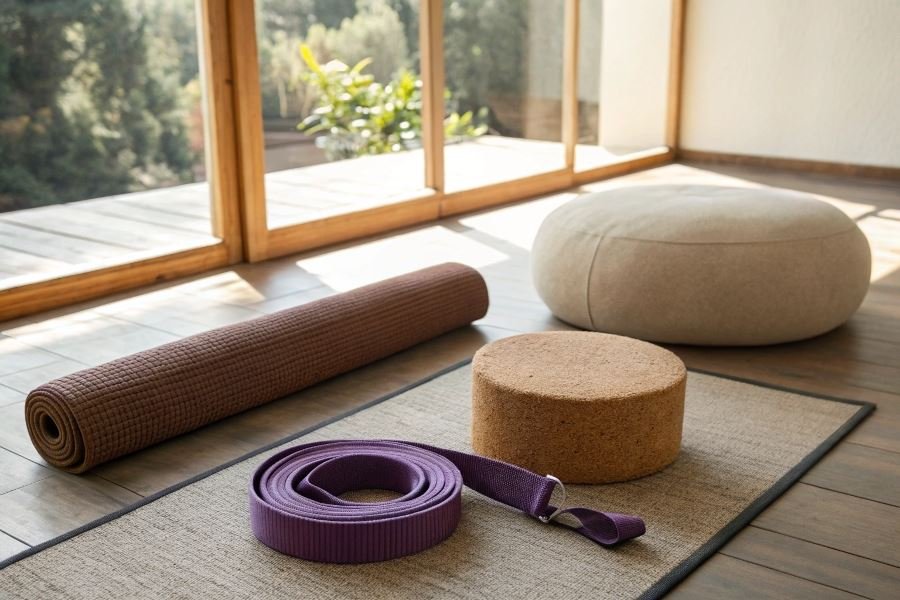
What if the secret to your perfect yoga pose isn’t more practice, but the right prop? Ancient yogis used tree branches and stones; today’s practitioners have an arsenal of specialized tools that can transform a frustrating practice into a revelation.
The journey of yoga props tells a fascinating story of innovation meeting tradition. While yoga itself dates back thousands of years, the systematic use of props as we know them today largely emerged in the mid-20th century through the pioneering work of B.K.S. Iyengar. His revolutionary approach democratized yoga, making it accessible to bodies of all types and abilities—not just the naturally flexible.
From luxury to necessity
Props have evolved from being seen as “training wheels” to essential tools that enhance even the most advanced practices. A well-placed block or strap doesn’t just compensate for limitations—it creates new possibilities for exploration and growth. Elite athletes and rehabilitation specialists now recognize that props offer precision that the body alone sometimes cannot achieve.
The alignment advantage
The magic of props lies in their ability to:
- Illuminate proper alignment when verbal cues aren’t enough
- Create space in compressed areas of the body
- Provide stability for challenging balance poses
- Allow practitioners to hold poses longer, deepening their benefits
Essential vs. specialized: Building your toolkit
Your prop journey typically begins with the foundational trio—blocks, straps, and bolsters—tools versatile enough to transform dozens of poses. As your practice evolves, specialized props like wheels, chairs, and wall ropes offer new dimensions of support and challenge. The beauty lies in finding which tools speak to your unique body and practice goals.
Essential Yoga Props That Transform Your Practice
When you step onto your mat, the right tools can make all the difference between a frustrating session and a transformative experience. The most popular props for yoga and their use have evolved from simple accessories to essential elements that help practitioners of all levels deepen their practice, prevent injury, and explore poses that might otherwise be inaccessible. Let’s dive into the game-changing props that belong in every yogi’s arsenal.
Yoga Blocks: Your Foundation for Growth
Yoga blocks might look simple, but they’re engineering marvels for your practice. These rectangular supports bring the floor closer to you when flexibility limits your reach.
Three key ways to use blocks:
- Support in standing poses – Place a block under your hand in Triangle Pose (Trikonasana) to maintain proper alignment without compromising your form
- Deepen seated forward folds – Sit on the edge of blocks to tilt your pelvis forward, creating space for your spine to lengthen
- Chest openers – Position a block between your shoulder blades while lying down for a supported heart opener
Pro tip: Cork blocks provide stability and weight, while foam blocks offer softness for restorative poses.
| Block Material | Best For | Durability | Price Range |
|---|---|---|---|
| Cork | Active practice | High | $18-30 |
| Foam | Restorative poses | Medium | $10-20 |
| Wood | Stability work | Very high | $20-35 |
Yoga Straps: Extending Your Reach
When your hamstrings scream “not today!” during forward folds, a yoga strap becomes your best ally. These simple bands create length where you need it most.
Game-changing strap techniques:
- Hamstring stretches – Loop around your foot in Seated Forward Fold to maintain a straight spine while gradually increasing your stretch
- Shoulder mobility – Hold the strap with hands wide apart behind your back, then slowly bring it overhead to improve shoulder flexibility
- Bind assistance – Use in twists when your hands can’t quite reach each other, allowing you to experience the full expression of the pose
The beauty of straps lies in their ability to provide instant feedback. That satisfying tension tells you exactly where your edge is, preventing the all-too-common “push through pain” mentality that leads to injuries.
Yoga Bolsters: Your Gateway to Deep Release
If blocks and straps are the workhorses of active practice, bolsters are the luxury vehicles of restorative yoga. These firm cushions support your body weight, allowing muscles to release completely.
Transformative bolster applications:
- Supported backbends – Place lengthwise along your spine for a gentle heart opener that requires zero effort
- Restorative child’s pose – Straddle the bolster lengthwise for a supported forward fold that releases lower back tension
- Meditation support – Sit with the bolster under your sitting bones or behind your back to maintain proper posture during longer sessions
The magic of bolsters happens when you surrender completely to their support, allowing gravity to do the work of releasing tension patterns that active stretching can’t touch.
When chosen thoughtfully and used correctly, these props don’t just improve your yoga practice—they revolutionize it, making the impossible accessible and the uncomfortable sustainable.
Elevate Your Practice: Mastering Yoga Prop Selection and Care
Investing in quality that lasts
When it comes to yoga props, quality isn’t just a luxury—it’s an investment in your practice and safety. High-grade materials make a tangible difference: a premium cork block provides stable support that won’t collapse under pressure, while a budget foam alternative might compress when you need it most.
Look for props with these quality markers:
- Durability indicators: Double-stitched straps, reinforced seams on bolsters, and non-toxic materials
- Eco-friendly certifications: GOTS for organic cotton, FSC for sustainable wood products
- Weight capacity specifications: Particularly important for wheels, blocks, and straps
The difference between a $15 and $30 yoga strap often comes down to the buckle mechanism and fabric quality. Metal D-ring buckles typically outlast plastic alternatives by years, while tightly woven cotton offers superior grip compared to synthetic blends.
The prop you buy twice is always more expensive than the quality prop you buy once.
Smart storage solutions for prop longevity
Your yoga props deserve better than being stuffed under the bed or tossed in a corner. Proper storage extends their lifespan and maintains their functionality.
| Prop Type | Ideal Storage Method | Common Mistake to Avoid |
|---|---|---|
| Yoga mats | Rolled loosely, stored in breathable bag | Folding (creates permanent creases) |
| Blocks | Stacked flat in dry area | Storing in humid environments |
| Bolsters | Standing on end or flat (rotate monthly) | Compressing under heavy items |
| Straps | Loosely coiled, hanging or in drawer | Tight knots or tangles |
Cleaning should become part of your routine. Most props benefit from a gentle wipe-down with diluted natural cleaners after use. Cork blocks and wooden props require special attention—avoid soaking them and instead use a damp cloth with minimal moisture.
Building your personalized prop practice
The most effective prop collection reflects your unique practice needs rather than following trends. Consider these factors when personalizing your prop arsenal:
Physical considerations:
- Current flexibility limitations
- Specific areas of tightness or injury
- Balance challenges or stability needs
Practice style alignment:
- Restorative practitioners benefit from multiple bolsters and blankets
- Power yoga enthusiasts might prioritize sturdy blocks and wheels
- Meditation-focused yogis often need supportive cushions and benches
Start with versatile essentials—two blocks, a strap, and a bolster create a foundation that supports nearly any practice. From there, expand based on the poses that challenge you most or the directions your practice is evolving.
Integration strategy: Introduce one new prop at a time, spending at least two weeks exploring its applications before adding another. This methodical approach prevents overwhelm and ensures you develop genuine skill with each tool.
Remember that props aren’t training wheels—they’re sophisticated tools that enhance awareness and deepen your practice. Even advanced practitioners benefit from thoughtful prop integration, using them not as crutches but as instruments of precision and discovery.